Wednesday, August 21, 2013

2013 Swapout + Aftermath

[n.b. This is a backdated post, part of a May/2014 blog catchup.  This post summarizes what was known about the state of the station as of August 21, 2013, which was a few weeks after our 2013 annual swapout operations.]

In the week of July 29th - August 2nd, 2013, a team from AOML traveled to the USVI to do our annual swapout of electronics on our St. Croix CREWS station near Salt River Bay.  Traveling from AOML were Rachel Kotkowski (NOAA Corps) and Mike Jankulak (UMiami).  José Sanchez of the Department of Planning and Natural Resources (DPNR) provided a boat and acted as boat operator for this work.

The backstory of this operation is that there had been some uncertainty about the station's power infrastructure.  Its four rechargeable batteries were first deployed in September of 2006 and could now be reaching the end of their useful lifetimes.  Since November of 2012, the station had been dropping transmissions mostly in nighttime hours, which could indicate insufficient power levels when running only on battery power, i.e. without the aid of current from the solar panels during daylight hours.

We arrived knowing only that we wanted to evaluate the battery situation, and potentially replace the batteries with off-brand rechargeable batteries procurable on the island, since the Odyssey PC1200 rechargeable batteries favored by the CREWS engineers could not be obtained locally.  During equipment removal we realized that one of the metal eyelets connecting the batteries to the station had snapped, effectively isolating the station from two of its four batteries.  It is not known whether this had occurred long ago or whether it happened during our operations, but we replaced the broken eyelets and cleaned the battery terminals for reinstallation.

There are three aluminum masts on this station that hold our aerial instruments (anemometer/compass, integrated "WXT" weather transmitter, and "BIC" light sensor) and which must be lifted out of their mounts and lowered to the boat for recovery/replacement.  These masts are 2 - 3 ft of aluminum that slide into very close-fitting fiberglass tubes and then are secured with locking bolts.  Removing these masts is always the most (physically) difficult part of this operation, as the space between the aluminum and fiberglass tends to accumulate dirt and bird guano and rain, all of which tends to act as a kind of concrete.  Also, lifting the masts involves grabbing them at a point above one's head and using force to push them even higher.  In the case of the BIC, there is a fairly heavy instrument to contend with as well.  See the photo of the empty WXT hole, below.
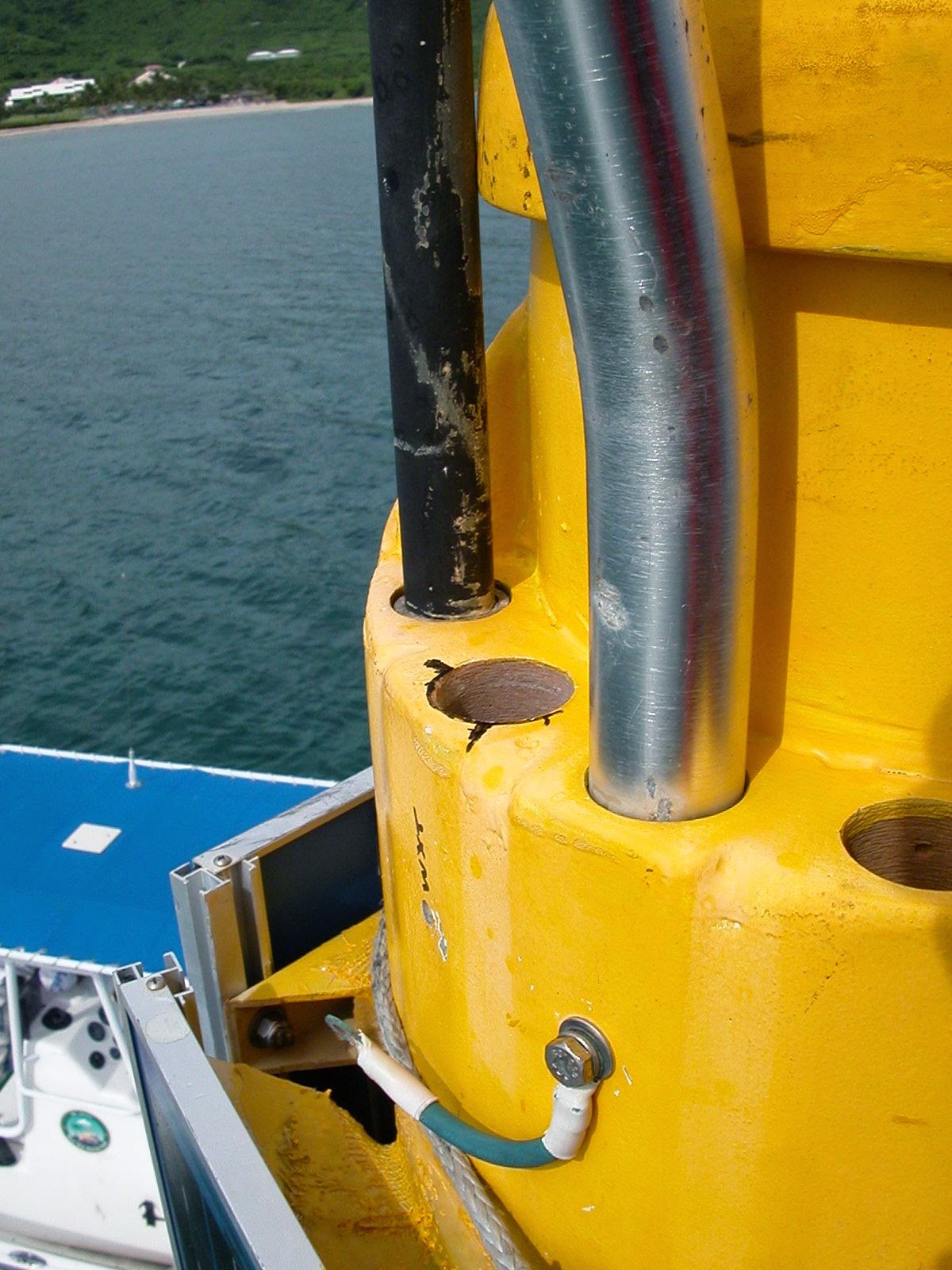
The empty hole where the WXT's aluminum mast would go, as seen in 2010.  Click this photo to see a larger version.
At this station the anemometer mast is generally the hardest to remove, but it usually comes free with prolonged effort and the use of lines and zip ties to allow the climber to use their entire weight to pull on the mast.  The WXT is generally easiest, and the BIC a little more difficult because of the sensor's weight.  However, at this 2013 swapout the BIC mast would not budge even a little.  It would not winch side-to-side, it would not shift up or down, it was solidly locked in place beyond all attempts to move it.

When faced with this unexpected situation I (for the first time) climbed high enough on the station to stand atop the solar panels and secure my lines to the satellite antenna.  From this point I was able to loosen the hose clamps that held the BIC to its mast and remove the sensor that way.  Unfortunately, on-land testing the next day revealed our replacement BIC to have mysteriously failed, so in the end I was forced to re-deploy the same light sensor I had just removed.  Deploying the sensor from this very high position was a little trickier than removing it had been, and on the whole I would not consider this activity to be within reasonable bounds of safety.  In the future we must either find another way of loosening the Surface BIC mast and extracting it as before, or resign outselves to leaving this one instrument in place permanently until the station itself can be recovered to land and its masts/mounts repaired or redesigned.

Mike J+ atop the station during the 2013 swapout.  At the far right is the BIC mast, which could not be removed, with its sensor already removed for (intended) replacement.  Click on this photo to see a larger version.
Another instrument problem befell the Shallow CTD.  Once it was deployed on the station its communications appeared to be functional and its depth/pressure values were reasonable.  However its Conductivity, Temperature and Salinity measurements were all off the scales.  We are now planning to ship a replacement CTD to St. Croix for later swapout by Marlon Hibbert (NOAA's Coral Reef Conservation Program) and José (DPNR).

Another piece of the power-infrastructure puzzle was the Deep BIC.  In July of 2012 it started dropping some of its reports (i.e. reporting less than its expected 120 measurements hourly at 30-second intervals), and in September the problem grew worse.  By November, when the station's power levels were showing signs of trouble, the fear was that the sensor might have flooded and could short-circuit the entire station.  A dummy plug was shipped to USVI in January and by the end of the month Marlon had removed this sensor and plugged its cable.  In a piece of relatively good news, we found on this visit that a connector pin on this cable had broken which explains the sensor problems and likely means that the recovered BIC was not flooded/destroyed.  We replaced this cable, and then went on to replace the underwater cable for the "groundtruth" CT when we found that it, too, was not working properly.  It made for a very long Thursday afternoon but we left the station with all communications functional.  As it happens, it was pin #2 (+12V power input) that was broken (BIC) or loose (CT) on both damaged cables.

Note that this means four of the station's original five underwater cables have now been replaced:  Shallow CTD (August 2010), Deep CTD (May 2011), Deep BIC (August 2013) and Groundtruth CT (August 2013).  Only the Shallow BIC cable is still original to the station's redeployment in 2006.

Rachel seen during replacement of the underwater sensors.  Click on this photo to see a larger version.
One final note: as of August 21st, and with the benefit of three weeks' worth of collected data following these operations, it seems the news on the status of the batteries has turned sour.  We were initially pleased to observe that station power levels returned to 100% normal patterns for the first 11 days following our visit.  Then on August 13th we dropped one transmission during the dark hours.  For four days, we dropped one or two transmissions per night.  Then three transmissions.  Then for the following four days, 5 - 7 transmissions were dropped per night.  We are now back to the same level of performance that we had pre-visit.  See chart of 2013 station voltages, below:

Battery voltages plotted against Julian Day, 2013, through August 21st.  Click on this picture to see a larger version.
The best conclusion, given the available evidence, is that the station's batteries must be replaced during the next swapout operation.

(signed)
Mike Jankulak

Friday, March 15, 2013

Station Maintenance

On Friday March 1, 2013 Interpretative Ranger Jose Sanchez and Coral Fellow Jennifer Travis traveled to the Salt River station for a routine maintenance trip and calibration.

Conditions were fair with sunny skies, Jose and Jenn attached the ground truth CTD at approximately 10:00 a.m.  It was retrieved after 2:00 pm.

All mesh screens were replaced on both the shallow and deep CTD and general cleaning of ropes, chains and the stick were completed.

Unfortunately the teams camera had technical difficulties and no pictures were able to be taken.

A next trip is planned for the week of March 18th , 2013.


Monday, February 04, 2013

Station maintenance

On Wednesday the 30 January 2013, a team from DPNR and the NOAA  travelled to the Salt River station under clear skies and rough seas. The station had not been attended to since November 2012, and at least two previous attempts were aborted due to unsafe weather conditions.


The weather conditions on Wednesday were challenging but with the help of Jose Sanchez , (STXEEMP Ranger), John Farchette ( STXEEMP Ranger) Jennifer Travis( NOAA CRCP Coral Fellow ) and NOAA Liaison ( Marlon Hibbert), we were able to remove the deep light sensor and change the sacrificial anodes on the base plate and on the chains.

A plug was placed on the light sensor as it had been dropping in and out of service. No further cleaning was attempted on the station due to the conditions , but it was observed to be in fair condition.


A basic cleaning and CTD validation is planned for mid February.

Pictures courtesy of Jenn Travis and Jose Sanchez

Friday, December 21, 2012

proposed removal of Deep BIC, St. Croix CREWS Station

[n.b. This is a backdated post, part of a May/2014 blog catchup.  This post's content is a slightly edited version of an email sent on December 21st, 2012, about signs of trouble with the station's Deep Light Sensor and our plans to correct the problem.]

The station's "deep" BIC has been dropping in and out of communications, with the first hints of trouble in July and more serious data gaps starting in September.  This isn't so worrisome in and of itself but beginning in late November the station's power levels have been fluctuating as well, which could indicate a flooding problem in the light sensor.  In extreme cases this could take the entire station offline due to power loss.

Our next visit from AOML to the station cannot happen until April or May at the earliest.  However, we will be shipping a collection of dummy plugs to Marlon Hibbert (NOAA's Coral Reef Conservation Program) and José Sanchez (USVI's Department of Planning and Natural Resources) so that they may remove the failing instrument and cap its cable during their next maintenance visit.

(signed)
Mike Jankulak

Thursday, November 15, 2012

Station maintenance

On Wednesday November 14, 2012 Jose Sanchez ( STXEEMP Interpretative Ranger) and I traveled to the SRV12 to conduct routine maintenance.

Conditions were not the best, winds between 12-16 knots with gusts up to 20 knots and seas running about 3-6ft. We were able to safely attach the calibration unit done at 10:40 am and it was retrieved at 2:25 pm. Jose cleaned all the ropes on  two dives and worked on the lower portions of the stick, base plate etc.

The zincs on the support chains will need changing, and the lower base plate zinc will need changing as well. Cleaning of the upper portion of the stick was not attempted due to the surge conditions and was deemed unsafe.

Checks on the data the day before revealed a possible issue with the deep light readings which measured a consistent -9 over the last 72 or so hours.

No pictures were taken on this trip.

Next scheduled event is mid December barring weather and unforeseen events.

Monday, September 24, 2012

Station maintenance

Station maintenance  was conducted a week after our planned September 10-17 date due  to some rainy and stormy weather conditions and some meetings for the update of the STXEEMP management plan. On a clear  almost flat day on September 21, 2012  Jose Sanchez, STXEEMP Interpretative Ranger and myself ( Marlon Hibbert) journeyed out to Salt River.

Pleasant conditions 
                                         
Before-deep CTD 
                                         
                                           
After - deep CTD 
                                             

Jose-roped to his work
                                         
                                               .

Jose - chipping away
                                                 
                                                   
Main  column - before


Main column-after 
                                                   
The big picture


Cleaning brought us many friends hunting for scraps


Spectators doubling as security guards


Cleaning has pitfalls -we saved this one. 

                                       
Jose's handiwork

                                                                                         
Paling of corals 

Pale Montastrea sp

Diseased-Meandrina sp 

Connected groundtruth CTD


The groundtruth CTD was connected at about 10:56 am and ran undisturbed for at least two hours. Jose cleaned and changed the mesh on the top CTD, but for the most part none were disturbed. The groundtruth CTD was disconnected at about 3:20p.m. just before our departure from the site.

A week before going to the site , a check on the data revealed conditions conducive to bleaching, on a brief swim around, we did observe some minimal paling that did not appear widespread and  was mostly species specific.

Next planned visit, Week of October 15, 2012.